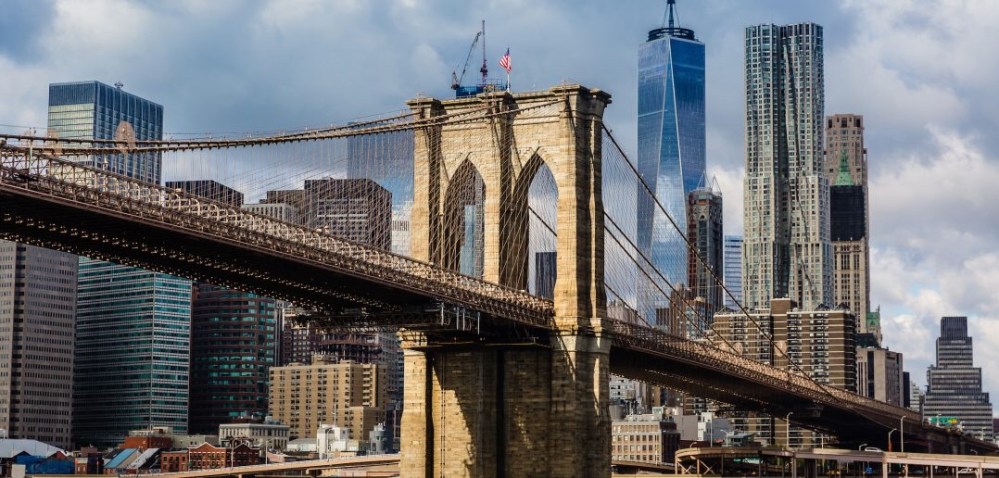
Brooklyn Bridge is one of the great icons of New York City
Walking across from the Brooklyn side is the preferred option because then you get amazing sweeping views of Manhattan. When you go across, you will truly feel that you are part of NYC history.
The Brooklyn Bridge is a hybrid cable-stayed/suspension bridge, with a main span of 486m. Total length of 1825m. It connects the boroughs of Manhattan and Brooklyn, spanning the East River.
The construction of Brooklyn Bridge has an amazing story –
Built between 1869 and 1883 it was the world’s longest span until the completion of the Firth and Forth Bridge in Scotland in 1890.
The bridge was conceived by German immigrant John Augustus Roebling in 1852, who spent part of the next 15 years working to sell the idea. Just before construction began in 1869, Roebling was fatally injured while taking a few final compass readings across the East River. A boat smashed the toes on one of his feet, and three weeks later he died of tetanus. His 32-year-old son, Washington A. Roebling, took over as chief engineer.
To achieve a solid foundation for the bridge, workers excavated the riverbed in massive wooden boxes called caissons. These airtight chambers were pinned to the river’s floor by enormous granite blocks; pressurized air was pumped in to keep water and debris out.
Workers known as “sandhogs”—many of them immigrants earning about $2 a day—used shovels and dynamite to clear away the mud and boulders at the bottom of the river. Each week, the caissons inched closer to the bedrock. When they reached a sufficient depth—13,5m on the Brooklyn side and 23,5m on the Manhattan side—they began laying granite, working their way back up to the surface.
The journey to and from the depths of the East River, however, could be deadly. To get down into the caissons, the sandhogs rode in small iron containers called airlocks. Many workers suffered from the disease known as “caisson disease” or “the bends”: excruciating joint pain, paralysis, convulsions, numbness, speech impediments and, in some cases, death. Washington Roebling himself, suffered from the disease, and remained partially paralyzed for the rest of his life. He was forced to watch with a telescope while his wife Emily took charge of the bridge’s construction for the next 11 years.

 East Coast of America Science Tour